

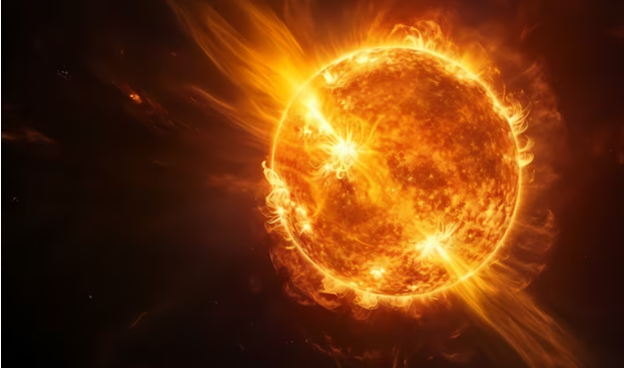
The Sun is the center of our solar system and the primary source of energy for life on Earth. Every day, it provides the light and heat needed for weather patterns, plant growth, and countless natural processes. Although the Sun appears calm from a distance, its core is the site of powerful nuclear activity that has continued for billions of years.
Understanding Nuclear Reactions in Sun helps explain how stars produce energy and why the Sun has remained stable for such a long time. The reason Nuclear Fusion Takes Place in the Sun is that its core provides the extreme conditions needed for hydrogen atoms to combine and release enormous amounts of energy.
What Are Nuclear Reactions?
A nuclear reaction is a process that changes the nucleus of an atom, often releasing or absorbing energy. Unlike chemical reactions, which involve electrons, nuclear reactions occur within the atomic nucleus.
There are two main types of nuclear reactions:
-
Nuclear fission, where a heavy atomic nucleus splits into smaller nuclei.
-
Nuclear fusion, where light atomic nuclei combine to form a heavier nucleus.
The Sun generates its energy through nuclear fusion rather than nuclear fission.
Why Nuclear Fusion Takes Place in the Sun
Many students wonder why Nuclear Fusion Takes Place in the Sun but does not naturally occur on Earth.
The answer lies in the conditions inside the Sun’s core. Temperatures reach approximately 15 million Kelvin, while pressure is so intense that hydrogen nuclei are forced close enough together for the strong nuclear force to overcome their natural electrical repulsion.
Under these extreme conditions, hydrogen nuclei fuse to form helium. During this process, a small amount of mass is converted into energy according to Einstein’s equation:
E = mc²
This energy eventually reaches the Sun’s surface and is emitted into space as sunlight and other forms of electromagnetic radiation.
The Proton-Proton Chain Reaction
Most Nuclear Reactions in Sun occur through a sequence called the proton-proton chain reaction. This is the dominant fusion process in stars with masses similar to the Sun.
The reaction follows three main stages:
-
Two hydrogen nuclei combine to form deuterium.
-
Deuterium combines with another hydrogen nucleus to form helium-3.
-
Two helium-3 nuclei fuse to produce helium-4 while releasing two hydrogen nuclei.
Each stage releases energy in the form of gamma rays, neutrinos, and other particles. Over millions of years, this energy slowly moves from the Sun’s core to its surface before radiating into space.
How Solar Energy Reaches Earth
Although fusion occurs deep inside the Sun, the energy produced does not reach Earth immediately.
Photons generated in the core undergo countless interactions with particles inside the Sun. During this journey, which can take thousands to hundreds of thousands of years, the energy gradually changes into lower-energy forms.
Once it reaches the Sun’s surface, light travels through space and reaches Earth in about eight minutes.
This steady flow of energy drives many essential natural processes, including:
-
Photosynthesis in plants.
-
The Earth’s climate and weather systems.
-
The water cycle.
-
Ocean currents.
-
The survival of nearly all ecosystems.
Without continuous nuclear fusion, these life-supporting processes would not exist.
Why the Sun Does Not Burn Out Quickly
Although the Sun releases an enormous amount of energy every second, it also contains an immense supply of hydrogen fuel.
Scientists estimate that the Sun formed about 4.6 billion years ago and is expected to continue producing energy through nuclear fusion for approximately another 5 billion years. As hydrogen is gradually converted into helium, the Sun maintains a stable balance between the inward pull of gravity and the outward pressure created by fusion.
This balance allows the Sun to remain stable over extremely long periods.
Why Studying Solar Nuclear Reactions Matters
Learning about Nuclear Reactions in Sun helps scientists understand not only our own star but also the life cycles of other stars throughout the universe.
Research into solar fusion also supports efforts to develop controlled nuclear fusion on Earth. Scientists hope that future fusion reactors will provide a cleaner and more sustainable source of energy by using the same fundamental principles found in the Sun.
Although practical fusion power remains under development, studying the Sun continues to improve our understanding of physics, astronomy, and energy science.
Conclusion
The continuous Nuclear Reactions in Sun are responsible for producing the energy that sustains life on Earth. The reason Nuclear Fusion Takes Place in the Sun is that its core provides the extraordinary temperature and pressure needed for hydrogen nuclei to combine into helium while releasing vast amounts of energy.
By understanding these nuclear processes, students gain insight into how stars function, why the Sun has remained stable for billions of years, and how its energy supports every major natural system on our planet. The study of solar fusion remains one of the most important topics in modern physics and astronomy.