

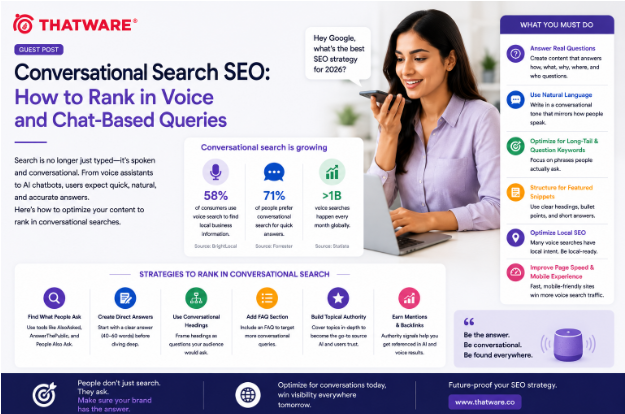
The way people type search queries has always been a little artificial. Short, clipped, keyword-dense phrases that nobody actually says out loud. “best coffee maker under $100.” “Paris hotel cheap.” “headache behind eyes causes.”
These shorthanded queries were a concession to how search engines used to work. Type the keywords, get the results. But search has been moving away from that model for years — accelerating sharply with voice search, and now reaching a new inflection point with conversational AI interfaces.
People don’t talk to AI assistants the way they used to type to Google. They use full sentences. They ask follow-up questions. They give context. “I’ve been getting headaches behind my eyes every afternoon for the past week — what might be causing that and should I be worried?” That’s not a keyword. That’s a conversation.
The Conversational Search Landscape in 2026
Voice search through smart speakers and phone assistants has been mainstream for years. But the real shift in 2026 is the growth of chat-based search — people using ChatGPT, Perplexity, Gemini, and similar tools as their primary way of finding information and answering questions.
These interfaces are fundamentally conversational. They support multi-turn exchanges, context retention, and nuanced follow-up. The query isn’t a string of keywords — it’s a request made in natural language, often with background context that shapes the response.
For SEO, this means the content that performs best isn’t necessarily the content that ranks for the most keywords. It’s the content that best answers the questions people are actually asking — in the natural, contextual way they’re actually asking them.
How to Optimize for Conversational Queries
The first move is rethinking your keyword research methodology. Traditional keyword research identifies high-volume search terms and builds content around them. Conversational search optimization requires identifying the questions your audience asks — the full, natural-language questions — and building content that answers them directly and completely.
Tools like “People Also Ask” sections, forum research (Reddit, Quora), and customer service logs are goldmines here. What are the actual questions real people are typing or speaking? Build content around those, in a structure that makes the answer immediately clear.
FAQ sections work remarkably well for conversational search. Not generic FAQ sections padded with obvious questions — but genuinely useful FAQ content that anticipates the specific concerns, confusions, and follow-up questions your audience actually has. These get cited frequently in AI-generated answers.
Schema markup for FAQ and HowTo content helps AI systems parse your question-answer structure correctly. It’s one of the higher-ROI technical SEO moves you can make right now specifically for conversational and AI search performance.
Long-form, comprehensive content that covers a topic from multiple angles — including the natural follow-up questions — performs well in conversational AI because it can satisfy an entire thread of related questions, not just one.
Conversational search SEO consulting is increasingly focused on this question-mapping work: systematically identifying the conversational queries your audience uses, structuring content to answer them directly, and ensuring the technical foundations allow AI systems to parse and cite that content effectively.
Voice-Specific Considerations
Voice search has its own nuances. Spoken queries tend to be longer and more natural-language than typed queries, but also more local and more action-oriented. “Where can I get good ramen near downtown” is a voice query. “What’s the best way to store fresh herbs so they last longer” is another.
Voice search results are typically pulled from featured snippets or structured data. Optimizing for voice means optimizing for featured snippets: concise, direct answers that appear in paragraph form, list form, or table form at the top of search results.
Position zero is the goal for voice — the single result that gets read aloud. That requires extremely direct, well-structured content that directly answers the specific question being asked.
Working with an AI SEO strategy consulting partner who understands both the conversational AI dimension and the voice search dimension — and how they overlap and diverge — gives you the most comprehensive approach to this fast-evolving piece of the search landscape.